
Aiken County Sex Offender Checks
The Aiken-branded SORT gateway is the official local entrance to the South Carolina Public Sex Offender Registry. SLED manages the statewide system, while the Aiken County Sheriff's Office registers people, checks required information, and sends updates to SLED. The registry is free and does not publish a login or search fee.
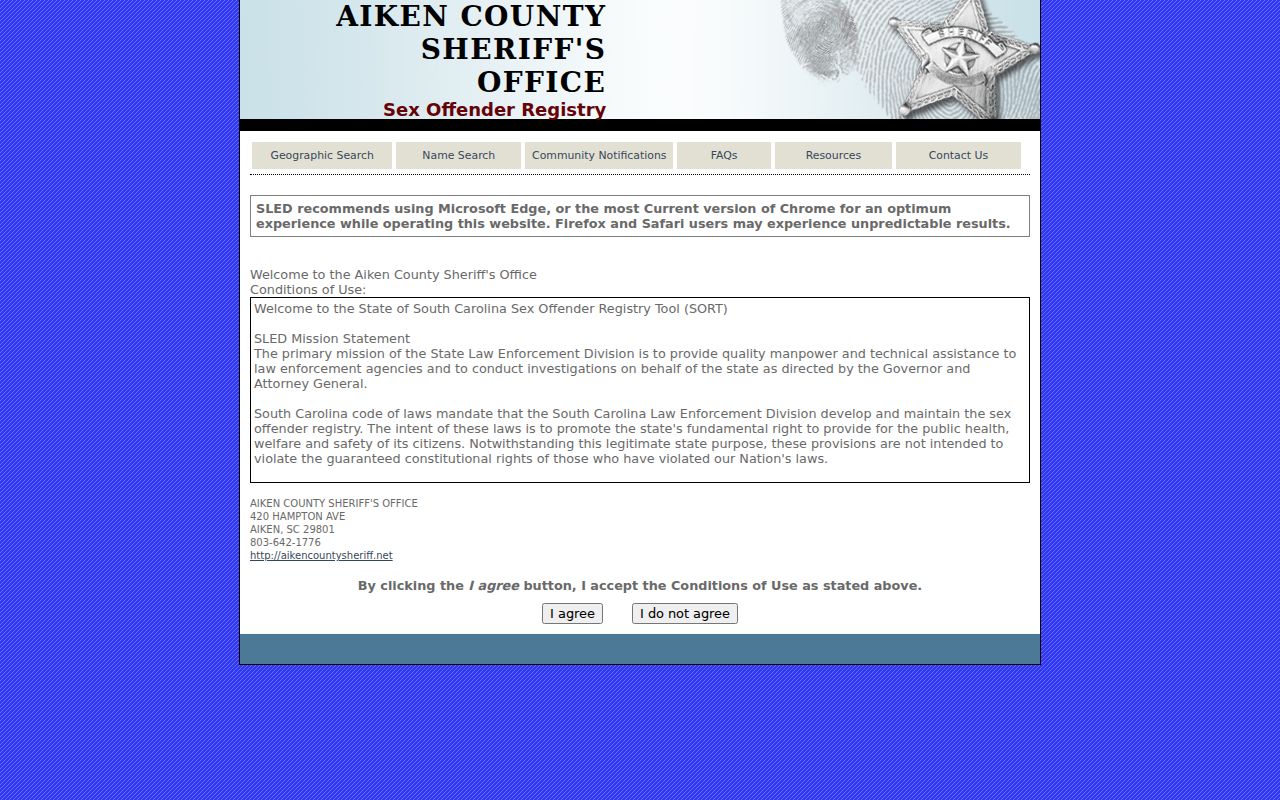
The gateway names ACSO at 420 Hampton Avenue and gives a registry line of 803-642-1776. The official sheriff directory confirms the law-enforcement center location. No local registration hours or appointment fee were posted, so call before visiting. Registry questions and corrections can also go to SLED at 803-896-2601 or sor@sled.sc.gov.
Aiken County Registry Update Chain
A person subject to South Carolina registration must report to the sheriff in each county tied to a residence, property, work, or school duty. Address and move notices generally must be made within three business days. A temporary residence includes a stay of ten or more consecutive days. The sheriff then forwards changes to SLED within three business days.
This split explains why two contacts exist. Local registration and compliance questions belong with ACSO. A problem with a statewide public entry belongs with SLED. If an Aiken County address appears stale, save the profile details, note what seems wrong, and contact the correct office. Do not confront the listed person or assume the public record tracks movement in real time.
The registration chain can involve more than a home address. A person may have duties in each county connected to work, school, owned property, or a temporary stay. Aiken County officials collect the local change, and SLED maintains the statewide public system. Checking both roles prevents a searcher from sending an interface correction to a local records desk that cannot change the state display.
Note: A SORT address is reported registration data, not GPS tracking or a guarantee that a person is present now.
South Carolina Public Sex Offender Registry Searches
The SORT search begins with conditions and a CAPTCHA. That gate is part of the normal public process. After acceptance, the interface offers name, geographic, and community-notification paths. The CAPTCHA prevented research from confirming exact radius choices, so use only the options the live Aiken County registry displays.
- Open the official registry and read the conditions of use.
- Choose “I agree,” enter the displayed code, and continue.
- Select Name Search or Geographic Search and enter the live form's requested details.
- Compare the result with aliases, physical details, address, and qualifying offense before opening the full profile.
| Control | Type | Required | Purpose |
|---|---|---|---|
| Conditions | Acknowledgement | Yes | Agree or decline before access |
| Code | CAPTCHA text | Yes | Continue or request a new code |
| Geographic Search | Tab | No | Location and map search |
| Name Search | Tab | No | Search for a known name |
| Community Notifications | Tab | No | Register for alerts |
Aiken County Registry Search Layers
Name and geography answer different questions. A name search is suited to a known identity. Geography helps with Aiken County community awareness. For a search that may cross the Savannah River or another state line, the U.S. Department of Justice's National Sex Offender Public Website adds a national layer.
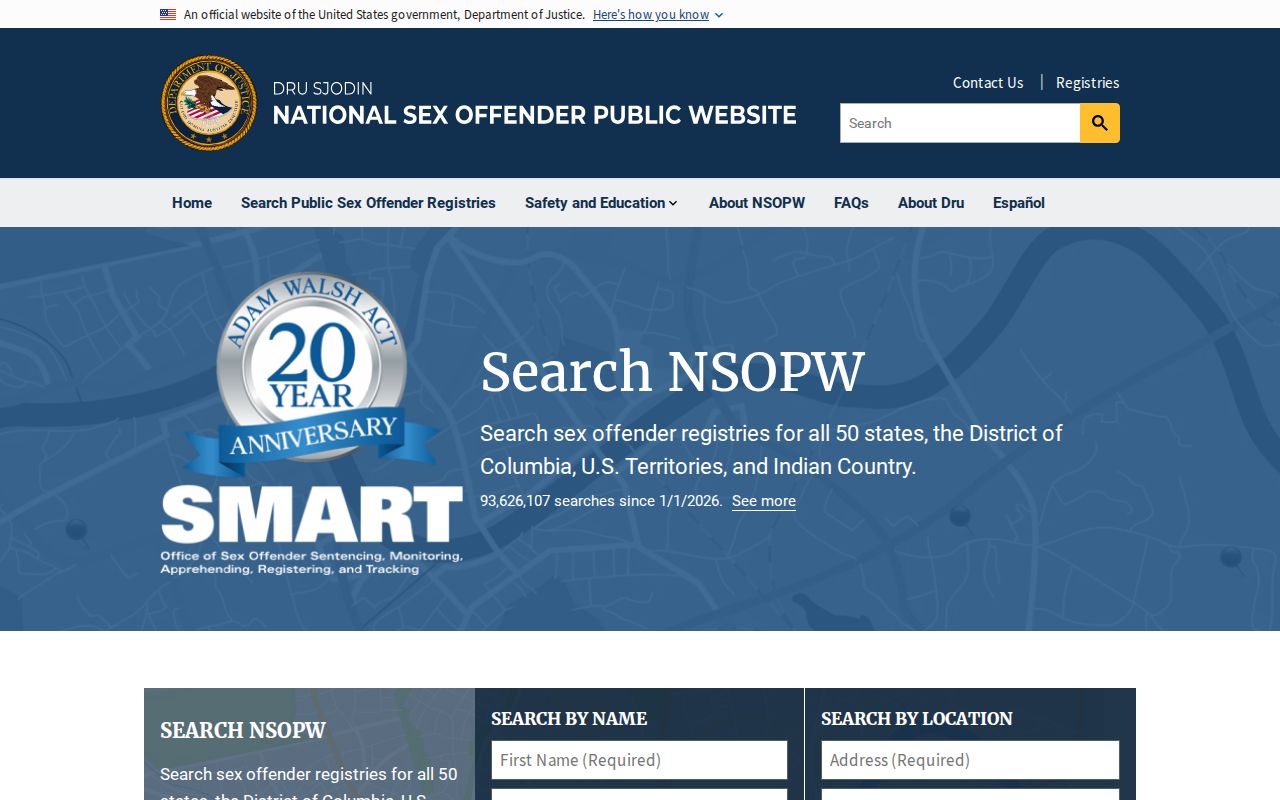
NSOPW draws from participating jurisdiction registries. It does not replace the Aiken County and SLED update chain, and a national result should still be checked at the originating registry. For a written or electronic statutory request, South Carolina law permits a request for a specific registrant or a city, county, ZIP, or state list. A reasonable distribution fee may apply, but no fixed Aiken County price was found.
Registry Profiles: What They Show
A public Aiken County registry profile can show enough detail to distinguish one person from another and understand the registration basis. It may display several photos, aliases, physical descriptors, reported permanent or temporary address, a map, and qualifying offense information. The conditions warn that self-reported details may be unverified or out of date. Inclusion does not state that a person poses a current danger.
| Name and aliases | Full public name plus alternate names reported to the registry. |
|---|---|
| Photo and description | Current or multiple photos with age, race, sex, height, weight, hair, and eyes. |
| Reported address | Permanent or temporary residence information and a public map. |
| Qualifying offense | Offense description and statute tied to the listing. |
| Conviction details | Conviction date, city, and state when public. |
| Tier or status | Not confirmed as a public field in the accessible profile interface. |
South Carolina collects additional registration data, including fingerprints, vehicles, internet identifiers, and other sensitive items. The statutory public response is narrower. Do not assume every field collected by the sheriff appears on the public profile.
The accessible interface did not confirm that a public profile displays tier, victim age, tattoo data, compliance labels, or verification dates. Those items should not be inferred from other states' registries. Match only the fields SORT actually shows. When several names are similar, aliases, photographs, physical details, conviction place, and the reported address help avoid selecting the wrong profile.
Aiken County Registry Alerts
SORT provides a separate Community Notifications route. Accept the conditions, enter the code, select the notification tab, complete registration, and accept its terms. People who subscribed under the prior system had to enroll again after the SORT migration. An old alert signup should not be assumed active.
South Carolina also requires a sheriff to notify schools and day care centers within one-half mile when the statutory conditions apply. That official notice duty is distinct from an optional resident alert account. Both are designed for awareness, not confrontation. When an alert and an Aiken County profile seem inconsistent, confirm the current registry entry and contact ACSO or SLED.
Registration Levels and Duties in South Carolina
South Carolina's tier labels affect the earliest removal route, but the baseline duty is lifetime registration. Tier I and Tier II registrants verify twice each year and may apply to SLED only after their statutory clocks and other conditions are met. An adult Tier III registrant has a later General Sessions motion route. A person classified as a sexually violent predator reports on the highest-frequency schedule.
| Tier or status | Baseline | Earliest removal route |
|---|---|---|
| Tier I | Twice yearly for life | SLED application after 15-year clock and conditions |
| Tier II | Twice yearly for life | SLED application after 25-year clock and conditions |
| Tier III adult | Twice yearly for life | General Sessions motion after 30 years |
| Sexually violent predator | Every 90 days unless in custody | Separate highest-frequency status |
Removal is not automatic. SLED's application fee is capped at $250. SLED checks registry and fingerprint records, and the original prosecutor may object. A qualifying administrative decision is due within 120 days. A denial can be appealed, while another application normally must wait five years. Multiple convictions use the highest applicable tier clock.
A 15-, 25-, or 30-year clock is only the earliest point for the stated route. It is not an expiration date. The applicant must meet statutory conditions and complete the proper SLED or General Sessions process. Until removal is granted and the registry is updated, the lifetime baseline remains in place.
Aiken County Registry Distance Rules
The well-known 1,000-foot residence restriction does not apply to every person on the Aiken County registry. South Carolina limits that rule to specified convictions and circumstances. A map distance alone therefore cannot establish a violation. The qualifying offense, conviction details, and current law must be read together.
Registration duties are broader than the residence rule. Work, school, property, and temporary-residence ties can create county reporting duties. Changes generally go to the sheriff within three business days. If the question is whether a specific location complies, call the ACSO registry line. Public map data is a starting point, not a legal finding.
Correcting Aiken County Registry Entries
Start by separating local registration facts from the statewide display. Contact ACSO at 803-642-1776 for a question about Aiken County reporting or compliance. For an apparent error in SORT, contact SLED at PO Box 21398, Columbia, SC 29210, call 803-896-2601, fax 803-896-2311, or email sor@sled.sc.gov. Describe the entry and the claimed error without posting private information elsewhere.
The public interface cannot confirm every intake field or every geographic radius because access is gated by CAPTCHA and the public response is narrower than the full registration file. An absent field does not prove the sheriff failed to collect it. An old address also does not establish a crime without agency verification.
If the concern is immediate noncompliance or danger, contact law enforcement rather than trying to investigate. For a routine data issue, give SLED the profile information and a concise description of the suspected error. That preserves the official correction trail and avoids spreading a claim that has not been checked.
Using Registry Information Lawfully
Registry information supports personal and family safety, community awareness, and informed contact with law enforcement. It must be read with care. The official SORT conditions of use warn that reported information can be unverified or outdated and prohibit unlawful harm, harassment, threats, or crimes.
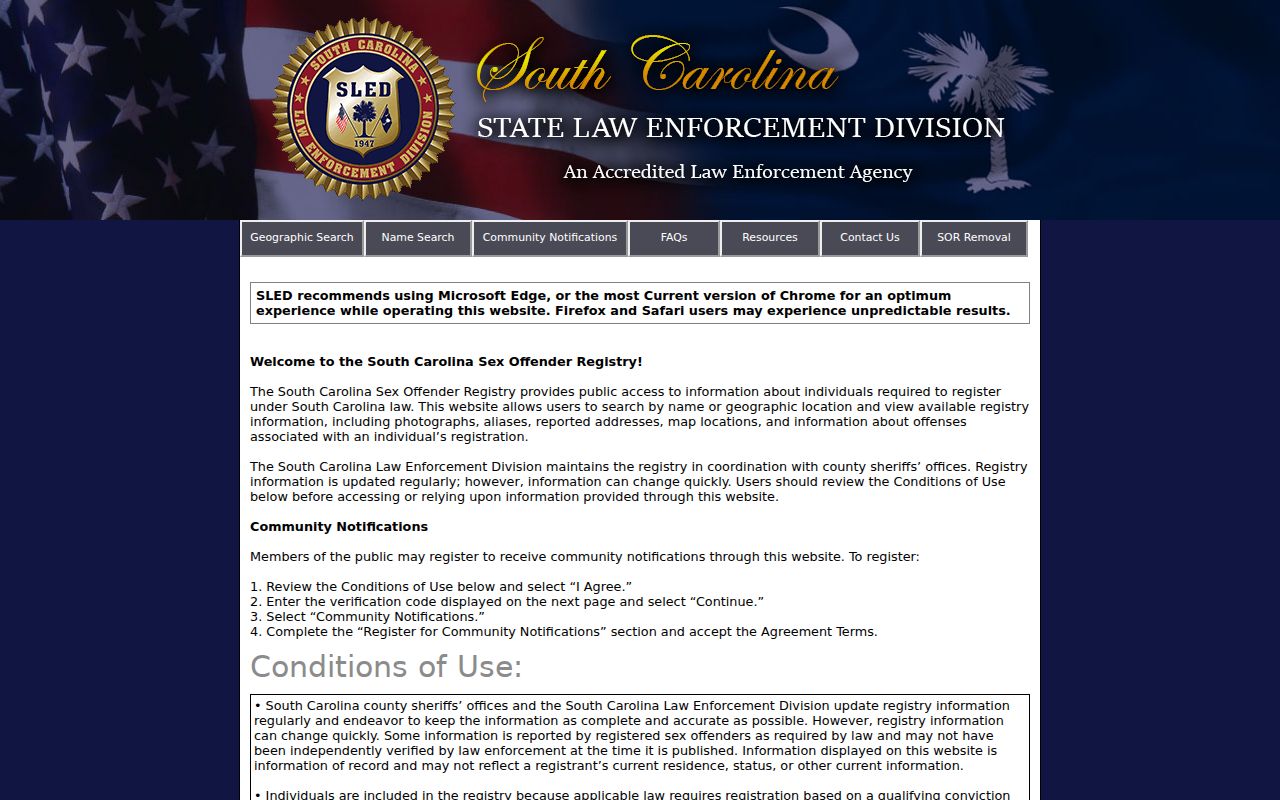
The conditions image is part of the search path, not a formality. A listing should be verified through official records, and urgent safety concerns should go to law enforcement.
Misuse is a crime: S.C. Code §23-3-510 prohibits using registry information to injure, harass, threaten, or commit a crime. Registry-enabled crime can increase the available penalty.
Section 23-3-510 can add up to $1,000 and six months to misdemeanor limits or up to five years to a felony maximum. Do not contact, follow, expose, or threaten a registrant or household based on an Aiken County registry result.